Virtual Thematic Issue on Additive Manufacturing: Introduction
Editors: Andrea Tridello and Filippo Berto
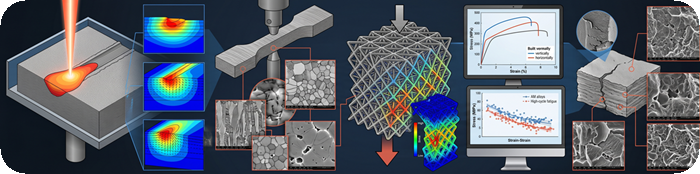
Additive manufacturing is reshaping the way engineering materials and components are conceived, produced, and assessed. Beyond its role as an alternative production route, it offers new possibilities for design freedom, material efficiency, functional customization, and the rapid development of complex parts. The papers collected in this Virtual Special Issue reflect the breadth and multidisciplinary nature of current research in additive manufacturing. They show that understanding the performance of AM components requires an integrated view of the process, the material response, the resulting structural features, and the conditions experienced in service. This integrated perspective is essential for understanding how printed components perform under mechanical, thermal, and operational loading conditions.
A central theme emerging from the collection is the need to connect process parameters with the structural integrity and reliability of the final parts. Experimental testing, advanced characterization, and predictive modelling are accordingly presented as complementary tools rather than separate approaches. The studies also show how numerical simulations, failure criteria, thermographic techniques, and multiscale models can support the interpretation of complex damage and deformation mechanisms. Such methods are particularly important when AM is applied to components intended for safety-critical or high-performance sectors, where durability and repeatability are essential requirements. At the same time, the variety of materials and configurations considered - spanning metals, polymers, hybrid systems, and indirect AM processes - highlights the versatility of AM across a wide range of applications.
Moreover, the selected contributions show that the transition of additive manufacturing from research and prototyping to real engineering applications depends not only on process optimization, but also on a deeper understanding of the relationships between manufacturing route, material structure, and mechanical response. Through practical case studies, including automotive components, biomedical devices, architectural restoration applications, and structural materials, the issue demonstrates the relevance of these aspects under realistic design and service conditions. In this sense, AM represents both an opportunity and a challenge for modern engineering research, calling for integrated methods capable of supporting design, qualification, monitoring, and performance prediction. By bringing together these contributions, this Virtual Special Issue provides a coherent overview of the current state of research in AM, while highlighting ongoing efforts to improve the reliability and applicability of AM components in real-world contexts